Mountain Bike Reviews Forum banner

Tight Bushings = Harshness

327K views 1.2K replies 191 participants last post by  JB450  
#1 · (Edited)
Do you think your fork feels harsh over small bumps?

Chances are your fork lowers may have tight bushings, which is quite common! Especially on brand new forks.

I knew mines were not great ... I had to apply way too much force and wiggle the stanchions almost all the way to make the uppers slide into the lowers while servicing the fork. How could they be great at dampening small vibrations that don't generate enough force?? Once I realised that ... I ordered a tool to resize them.

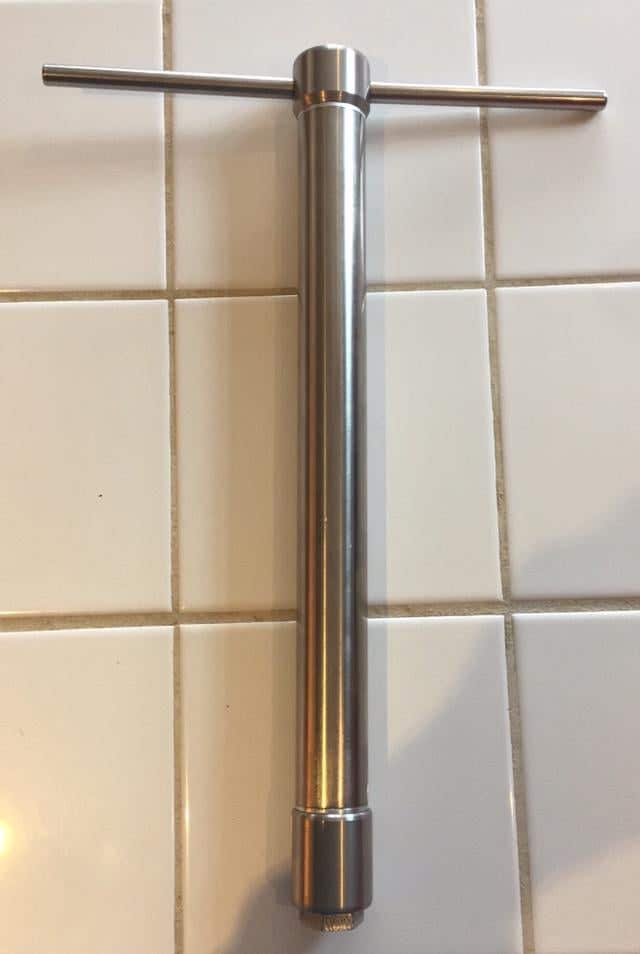
Fork Bushing Sizing Tool

Image


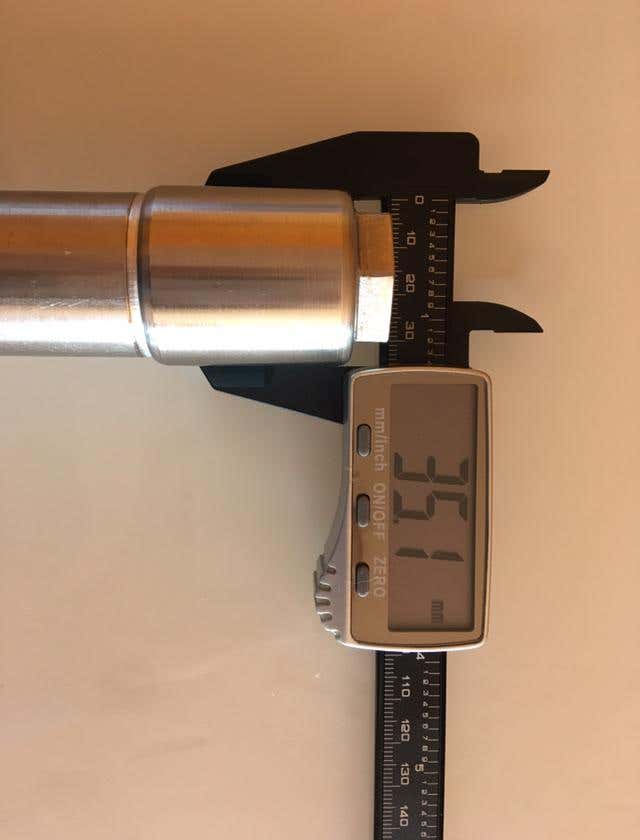
Once received I measured the "head" on the tool to use with 35mm stanchions at 35.1mm.

Image


Fox say correct bushing tolerance is a diametric clearance of

min: 0.0015" (0.0381 mm)
max: 0.0090" (0.2286 mm)

source: https://www.ridefox.com/fox_tech_center/owners_manuals/07/eng/bushing_technology_and_inspection.htm

That +0.1mm (0.003937") to resize/widen the bushings is perfect.

If you do the math and take Fox's recommandation to see what the result should be, you get:

(0.0090"-0.0015")/2 = 0,00375" (0.95mm)

Which is right in the middle!

RS doesn't even list the bushings on their "Spare Parts Catalog" because they are made to last forever (basically if the fork is well maintained, you won't have to worry about it), so I guess they make them a bit tighter now to backup that claim

Truth is, most of the time they are too tight and when people scratch their head and try to improve small bump compliance by tweaking x or y they miss the main culprit (tight bushings), it generates a ton of frictions and from there it's an uphill battle.

Do a test next time you service your fork.

1 - Drop the lowers
2 - Remove the damper/spring
3 - Remove the seals
4 - Cycle the uppers into the lowers by hand (with nothing else)

You'll be surprised (or shocked. LOL) by how much force you need to cycle the uppers ... I can almost guarantee they won't fall down like mine! If it's the case then your bushings are too tight/narrow.

Image


Out of 3 forks I serviced recently (Pike/Lyrik/Yari), including my own they were all sticky and hard to cycle, you had to slightly move the uppers side to side to push them down ... and apply force at the same time!

Once I resized the bushings, well ... have a look at the gif, the uppers now drop under their own weigh into the lowers.

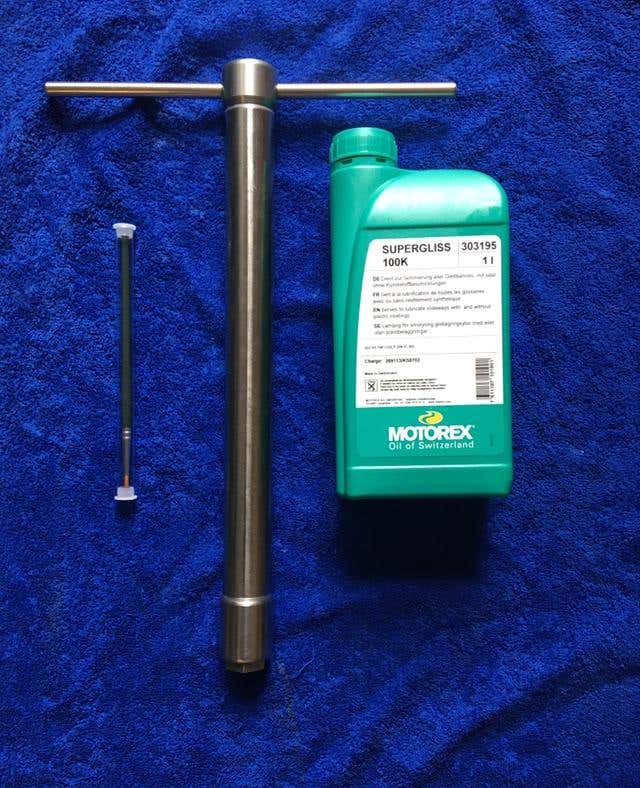
It's very easy to use the tool, just force it through the bushings with a twisting motion and you'll have perfectly honed out bushings in your fork. (apply some Motorex Supergliss on the head and on the bushings with a long paint brush before)

If you want to do it, you've got 3 options.

1) - Make it done by a proper suspension specialist/tuner (it's nice to do it when you need servicing or tuning)
2) - You could buy the Fox tool for about $1000, yeah you read that right (ref: 803-00-813), that includes all the diameters they make (32/34/36/40)
3) - Or you could ask Oliver at Blue Liquid Labs | An Oliver Majewski Project to make you one for 140USD with any head diameter you want/need (that's what I did)

And don't forget to lube them with a nice slippery oil such as the Motorex Supergliss 100k (Big thanks to Dougal for testing and releasing that info)

Image


Resizing your bushes will give you slick, super smooth, stiction free action ... IMO that's the number 1 thing to verify and correct if necessary before modifying anything else. You can definitely feel the difference over small bumps and chatter it's incredibly supple off the top now.

because the fork doesn't need a lot of force to start moving/reacting and make those stanchions slide (they are not micro-stuck like before). it's a bit like when you have seized bearings on your frame, because of the weight/leverage AND it probably happened over a long period of time you can't really tell ... until you swap them for fresh ones and all of a sudden it feels like a brand new bike and your shock can do it's job to dampen small vibrations and chatter, NOW you can feel it ... well it's the same feel :)

I hope it will be helpful for some of you!

Some comments about tight bushings ...

TF-TUNED (MTB suspension tuners in the UK) say:

They simply won't "bed in" as is commonly believed & the bushes need re-sizing. This process involves changing the shape of the bush within the lower leg, to fit the stanchions better and prevent binding when the leg is passed through.
source: https://www.tftuned.com/tech-help/22-rockshox

Fox about Race Prepping a Fox 40

With the stanchion carefully set aside, Kolja does one of the things that he says makes the biggest difference to the feel of the fork-he works the bushings. With mass manufacturing the tolerances for the bushings is tight, opening the bushings does have an effect on the life of the fork, which would mean the fork would need servicing much sooner. By opening the bushing the fork moves more freely in its travel.
Source: https://www.pinkbike.com/news/race-prepping-a-fox-40.html
 
#27 ·
The only use I can see for a 36.0mm pilot is to force one that is way out of shape (i.e egg shaped from install) into the first stage of round so you can use the normal burnishing head.

What this process does is effectively the same as a lot of riding. What was known as "fork break-in". The forks that have had a good seasons riding (as long as they haven't damaged stanchions) end up perfectly sizing themselves.

My sizing tools are in this post:
Image


Made these myself, sizes from 28.6mm through 40mm. Not all of them are shown there.
We have found 35mm Marzocchi is smaller than 35mm RS. You'd need a tool for each of those.
 
#3 ·
If your fork bushings are tight, the fork can feel great after a service but gets sticky really quickly as the tight bushings plow the lube oil off the stanchions.

Bushing clearance for ideal sliding is about as much clearance as you can run without creating noticable play or knocking. The clearance is needed for lubrication film.

RS and Fox have tightened up their fork bushings a lot in the last few years. Fox went from ridiculously sloppy to almost Ohlins tight.
 
#4 ·
Thanks Dougal, it's always nice to hear about your experience and feedback [emoji106]

The most ridiculous was an almost brand new Pike ultimate, I've had to use the tool about 10/15 times in each leg before it went smooth ... shockingly tight!

BTW: thanks a lot for the Supergliss 100k, it's ridiculously good, I'm hooked :)

Using a small paint brush to lube the bushings, it was not even dripping, it's sticking to the surface but it's super slippery at the same time ... perfect for the job. So glad to have 10cc of this amazing oil in each leg now!
 
#5 ·
Great stuff. I had the exact same problem. Brand new 2019 RS Rev fork. TERRIBLE stiction off the top and just notchy/harsh throughout the entire stroke. Sent it back to SRAM for warranty. Of course they didn't do anything other than service the lowers and call it 'good' for the very reasons you listed above. So I sent it off to Ryan @ Fluid Focus.

Tight bushings. He honed them, rebuilt the lowers and sent it back and said enjoy...and he was right. It is smooth as glass now.
 
#11 ·
Great stuff. I had the exact same problem. Brand new 2019 RS Rev fork. TERRIBLE stiction off the top and just notchy/harsh throughout the entire stroke. Sent it back to SRAM for warranty. Of course they didn't do anything other than service the lowers and call it 'good' for the very reasons you listed above. So I sent it off to Ryan @ Fluid Focus.

Tight bushings. He honed them, rebuilt the lowers and sent it back and said enjoy...and he was right. It is smooth as glass now.
Glad he did a proper job! It's too often overlooked. Hence why you should go to a REAL suspension tuner ... easiest and safest way to enjoy the benefit of a slick suspension!
 
#6 ·
Great post!

I recently did the 200 hr service on my Recon RL and while I did lightly wet sand the bushings, I am now kicking myself for not checking fit with the guts removed.

On a similar note, when I tore my rear suspension apart for inspection on my Marin Rift Zone; four out of the six bearings felt crunchy. But once I pressed them out of the frame and rocker they felt fine.

Calipers came out to confirm my suspicion. All the bearing bores were way too small. I'd say about 0.001" interference fit is good for a bearing of this size, and they were all -0.006"!

I ended up designing and making a custom tool to resize these bores,while retaining cylindricity. New Enduro Max bearings run beautifully installed and the bike is much better at ironing out the small stuff.

Sent from my 2PZC5 using Tapatalk
 
#13 ·
Could the stock bushings be replaced by those?

https://www.igus.com/product/3

Image


Do the mechanical properties match what's needed for a MTB fork?

Example:
------
Maximum running speed, linear, continous
1,575 fpm (8.0 m/s)
Maximum running speed, linear, short-term
1,969 fpm (10.0 m/s)
Coefficient of sliding friction, dynamic, against steel
0.06 - 0.18 ÎĽ
------

They make them in:

35mm ID - 39mm OD
36mm ID - 40mm OD

ID is fine but what about the OD?

And you can request a free sample ;)
 
#17 ·
Could the stock bushings be replaced by those?

https://www.igus.com/product/3

And you can request a free sample ;)
I have worked with Igus before and they make a great product. They sell direct to consumer and their technical sales people are super helpful. You could reach out to them with the details of the application and they will help you select the correct bushing material.

I'm pretty sure they will even do custom sizes, obviously at a higher price point.
 
#20 ·
What's stopping them uppers from dropping completely in? Looks like you are dropping them through the first set of bushings and then they are stopping on the second set of bushings? If that's the case, seems like there may be more gains to be had with figuring out a way to align the bushing bores better?

Aren't the stock bushings lined with PTFE, basically making them a metal backed IGUS bushing?

How consistent in sizing are the stanchions?

0.0015" to 0.009" is wider then what I thought it would have been. Wonder how open you can go before it starts making noise.

Anywhere in the USA selling supergliss?
 
#22 ·
Thanks! Even regular bike shops can buy it without breaking the bank. If customers don't ask yet that's because they don't know about the whole bushings thing but if you explain it to them and add that service as part of the regular maintenance you do on forks, I'm sure they'll be pretty happy!

But even just for one guy, it's worth it ...

How much is your bike? How much is your fork? How much do you spend on BS upgrades because ... we all do ;) then you realize it's really not that expensive knowing you will keep it forever and the «regular» forks aren't going anywhere soon ... RS will keep their 35mm stanchions for a very good while and if they ever change ... you just need to spend a few dollars to buy a new (head) and boom ... you're back in business! Just an example of how futur proof it is ...

It's proudly made in the USA and you will support a very clever guy trying to improve our MTBiker's life with ingenious solutions/tools without murdering anyone with stupid prices! Super easy to deal with and very fast turnaround.

I'm from Europe but I know you guys like that kind of stuff ;)

Oliver Majewski is a bicycle mechanic, engineer and machinist specializing in the stuff that you can't get anywhere else.
I like that, I like that a lot. LOL [emoji16]

Have a look at his website: http://blueliquidlabs.com

Plenty of custom stuff/tools ... dig a little because not everything is visible from the homepage! I'm actually trying to increase my SB130 travel to something that's not even possible on the market (just because) ... but he can make custom (everything) to make it happen. Really good stuff and really interesting...
 
#23 ·
Glad Oliver is getting some exposure. He's a good guy.

Just so we're clear: there is no downside to slightly more loose bushings until they start to make noise/rattle or compromise stiffness?

I thought more loose bushings created quicker wear and that was part of the problem of the older Fox forks.
 
#25 ·
Glad Oliver is getting some exposure. He's a good guy.

Just so we're clear: there is no downside to slightly more loose bushings until they start to make noise/rattle or compromise stiffness?

I thought more loose bushings created quicker wear and that was part of the problem of the older Fox forks.
Older fox forks either had tight bushings or a lot of them suffered from the bath oil migrating in to the air chamber or damper and running dry

Go back even further to some of the earliest fox forks and they had more bushing clearance and are still running mint to this day!

Oliver is a real smart guy, I've bought tools from him too and he makes good stuff
 
#24 ·
A .009"D clearance should basically make the fork un-usable...

.002-.004"D is a good target.

Loose bushings will wear the stanchions super fast also. The heel/toe action of the two bushings against the shaft will give a lot of force to the leading edge of the bushings.


And a .006"D interference of a steel bearing into an aluminum housing sounds like there is some major measurement error going on....at that point, you'd be breaking material on one side or the other. A .0005-.001"D interference is desired for a modest press fit. 5-10X that is damaging something, and the bearings aren't that flexible...

Also, hate to break it to you, but if you just posted it on a public forum prior to patent filing, whatever patent you get filed and accepted by the USPTO can be invalidated with zero effort. If you've got a good idea, don't tell anyone.
 
#30 ·
A .009"D clearance should basically make the fork un-usable...

.002-.004"D is a good target.

Loose bushings will wear the stanchions super fast also. The heel/toe action of the two bushings against the shaft will give a lot of force to the leading edge of the bushings.

And a .006"D interference of a steel bearing into an aluminum housing sounds like there is some major measurement error going on....at that point, you'd be breaking material on one side or the other. A .0005-.001"D interference is desired for a modest press fit. 5-10X that is damaging something, and the bearings aren't that flexible...

Also, hate to break it to you, but if you just posted it on a public forum prior to patent filing, whatever patent you get filed and accepted by the USPTO can be invalidated with zero effort. If you've got a good idea, don't tell anyone.
.009 is total clearance, which would be .0045 on all sides assuming everything is in alignment and the stanchion is centered. This the upper limit for all manufacturers. .006-.007 is the sweet spot

Bushings have a spring quality, so the bushing mandrel needs to be larger than the desired ending measurement because the bushings will shrink back a little bit. The biggest benefit is not resizing anyway, it's making the bushing round. Most are ovalized to some extent and fixing that is a huge upgrade
 
#29 ·
Excellent ... Glad you got it sorted! A nice video was probably the best way to show people what it really feels/looks like ... how do you want you fork to be smooth when it's locked like that [emoji24]

Nice one! Thanks for sharing!
 
#35 ·
Oh great, so 0.1mm is perfect! Didn't know about the oval to round thing ... either way it helps. Thank you very much for the clarification about sizing/shrinking/shaping [emoji106]
 
#40 ·
Image


Source: https://singletrackworld.com/2016/03/review-formula-35-forks/

While I totally understand the need for tighter tolerances regarding stanchions (because they are press-fit), why would they be equipped and spend time measuring the whole stanchions/bushings fit during manufacturing? Surely they would know if it was bollocks? I have a hard time to believe they would «just» say that and not do it ... they invite media for factory tours etc... that would be difficult to say something like that and not show it to them. No?
 
#43 ·
It could simply be someone in management who doesn't understand the basics and thinks "technology" will save them. I see that a lot.

That article sounds more like they are matching crown spacing to lower leg spacing. Many companies (including Fox and Marzocchi) have produced forks with crown spacing not matching the lower castings. Makes for a pretty sticky fork.
 
#47 ·
I would not put too much stock in tech claims from marketing material made by Italian companies, they are notorious for printing blurb that may as well be directly spat out by google translate. Then once you take Pinkbike’s “expert” interpretation of it, who knows what the original intent could be, they were probably describing a carbonara recipe for all we know

And can we please stick to metric measurements like normal civilized people? We aren’t in the 1950’s!
 
#53 ·
I would not put too much stock in tech claims from marketing material made by Italian companies, they are notorious for printing blurb that may as well be directly spat out by google translate. Then once you take Pinkbike's "expert" interpretation of it, who knows what the original intent could be, they were probably describing a carbonara recipe for all we know

And can we please stick to metric measurements like normal civilized people? We aren't in the 1950's!
Still getting flashbacks from a decade ago huh?
 
#48 ·
I'm italian and basically half of my Friends ride on a formula selva.
I don't comment that technical informations, but i assure you that formula should NOT be taken as a good example for bushings tolerance.
Most of them are trash within a year, there are so many cases of bad bushings and play that it can't be described as accidental, there is a problem in their method.

As a italian i really don't like to comment an italian company in a bad way ( also have their brakes which are amazing), but using formula forks as a example of excellence for bushings is so far from real that i can't pass on that.
Down here you buy a selva and you are aware that there are very high chances that you'll need to replace bushings after a season, everyone knows it.
 
#49 ·
Formulas have relatively loose bushings by design, to help lubrication (bushings aren't slotted) and be super smooth out of the box, obviously this has consequences on longevity. At least their bushings ARE replaceable.

Tolerances for press fit headset cups are 0.1-0.15mm. I have no experience with replacing stanchions or steerers but it would be hard, and scary, to think they would be looser than that!
 
#61 ·
Tolerances for press fit headset cups are 0.1-0.15mm. I have no experience with replacing stanchions or steerers but it would be hard, and scary, to think they would be looser than that!
Headset cups and stanchions are very different in forces and insertion depth. You could tap the steerer tube out of several popular forks today with a big rubber hammer!

Needless to say. Those are the ones with a reputation for creaking.
 
#50 ·
Fair enough! It was still good to read what everyone had to say about all this ...

You cracked me up with that «carbonara recipe» [emoji23][emoji23]

Just read something cool on the SKF website about the difference between PTFE and POM, especially designs and variants.

The POM composite (bushings) seem to have a lot of interesting features compared to the simpler PTFE design.

Especially for lubrification.

Image


Excellent in dirty environments due to lubrication pockets ... Optimized for minimal maintenance in difficult environments

Pockets in the sliding surface make these bushings suitable for applications that require minimal maintenance under difficult operating conditions, for example in contaminated environments where lubricant cannot be supplied continuously or frequently. Therefore, the grease reservoirs should be filled prior to installation. Despite of their compact design, POM composite bushings can accommodate heavy radial loads and are less sensitive to misalignment.
https://www.skf.com/us/products/pla...roducts/plain-bearings/bushings-thrust-washers-strips/bushings/designs-variants

https://www.skf.com/binaries/327-12...ies/327-120169/0901d19680090e01-SKF-bushings-thrust-washers-and-strips-1-EN.pdf

Image


Image


What do you think?!
 
#54 ·
Fair enough! It was still good to read what everyone had to say about all this ...

You cracked me up with that «carbonara recipe» [emoji23][emoji23]

Just read something cool on the SKF website about the difference between PTFE and POM, especially designs and variants.

The POM composite (bushings) seem to have a lot of interesting features compared to the simpler PTFE design.

Especially for lubrification.

Image


https://www.skf.com/us/products/pla...roducts/plain-bearings/bushings-thrust-washers-strips/bushings/designs-variants

https://www.skf.com/binaries/327-12...ies/327-120169/0901d19680090e01-SKF-bushings-thrust-washers-and-strips-1-EN.pdf

Image


Image


What do you think?!
Those bushing types are primarily used for rear shock eyelets under heavy rotation loads. They used to be lead coated on the inside for lubrication but now are mostly black PTFE with some red PU. The casings are a steel outer ring for strength with a bronze inner wear layer.

Fork leg bushings are lighter and simpler. Aluminium outer with creamy coloured PTFE:
Image
 
#51 ·
Digev, I watched again your video where your uppers just drop in the lowers. maybe i'm wrong but it almost look like the uppers stops when the stancions reach the first set of bushing. I'm asking because I have a have a 2015 acs3-ed fox 36 that i always found harsh. I'm trying to find the best way to assess if the problem comes from the bushing being too tight. Maybe others can help as well explaining the best way to validate or invalidate if a fork has that issue. Thanks!
 
#52 ·
When I dropped the uppers they were already in the first set of bushings THEN they stopped because they've hit the second set of bushing ... I guess it's almost impossible to accurately hit the second set so they can carry on dropping. But when you «manually» guide the uppers into the second set, push them down then pull them up a few times it's still super smooth, unlike before.

If you want to check if your fork suffers from tight bushings, you should:

Empty the fork completely and keep only the chassis (uppers/lowers). So you remove everything else from the equation. (Everything, even the fork seals or the front axle)

Then you cycle the uppers into the lowers by hand ... I'd suggest you do a dry run first (literally) so it's even more obvious if they are tight and/or oval!

you can also put only one stanchion into it's leg to see if one side is worse than the other but that's about it!

it's not rocket science, they either slide freely/smoothly or they don't, and if they don't ... well, it probably translates into some form of harshness while riding, (essentially at the beginning of the stroke) but the good news is ..., now you know what to do :)

Don't forget to relube the 4 bushings with a sticky and super slippery oil such as the Motorex Supergliss range with a paint brush and use the same oil to bath the foam rings and into your lowers.

Pick the best for your ambient temperature.

Image


Credits go to Dougal @ Shockcraft

Source: https://www.shockcraft.co.nz/technical-support/suspension-oils/fork-bath-oils
 
#57 ·
Based on your experience/knowledge, what (usually) generates the most frictions in a fork?

Bushings
Dust/Wiper seals
Air Spring shaft seal
Air Spring Piston seal
Damper shaft seal
Damper piston seal
 
#58 ·
Whatever has been implemented the worst really.

Any one of those can lockout a fork over small bumps if done wrong. X-Fusion made a dual quad-ring air piston which had so much stiction it could actually break the piston in two!

The real struggle is to get the sum total of all of those down to sub 2kg force while still having appropriate sealing.
 
#64 ·
Mojo Rising commenting about the forthcoming EXT ERA Fork ...

Part two of our occasional social media series '36 (or should it be 38?) reasons to wait for a new ERA in fork design from EXT before buying your next fork

Reason number 4: EXT have been benchmarking all the enduro fork options on the dyno to find out how much stiction there is in each single part of the forks… Dampers, air shafts, seal blocks, main seals and bushes have all been tested individually and as assemblies for static and sliding friction with and without side load. You would be amazed how much support comes from stiction in a long travel, single crown fork. so much that damping is largely irrelevant at many shaft speeds…
Reason number 5: EXT have tested a lot of different types of bushings and bushing materials in these lowers and have made massive strides forward in reducing static and sliding friction. This is music to our ears as we've learnt a thing or two about this and modified/changed/swapped/hacked countless sets of bushings over the years and nobody listened... Until now

Reason number 6: Reduce un-predictable stiction and you can add support with more predictable and configurable damping! I could write another 10,000 words on why stiction is the enemy of the bicycle fork and where it can come from but I won't bore you here!
Sounds familiar?

I really hope they publish something ... at some point. LOL

source:
 
#67 ·
I have lots of friction Problems on my Rockshox SID, I made a video:

The problem is even after passing 6 times a reamer/honing cylinder at 32.12mm it is still very hard. I think my fork needs more play due to dimensional problems. I have a 32.22mm cylinder which does not enter absolutely, even with a chamfer, if I force too much, the bushings are getting damaged.

So I wonder if I can sand paper them, and then pass the 32.22mm bushing, I know it's not ideal , but it's working so bad right now.
 
#68 ·
There is an issue larger than just undersized bushings with your fork. There is no reason to go larger with burnishing the bushings. If 32.12 (which is already slightly larger than ideal) doesn't work, than you likely have some sort of larger issue.

Your video looks as if it moves relatively smoothly when there is no side load added and the forces are straight. Once you start pushing off from one side then it gets tight and binds. This would leave me to believe that it's most likely a machining error in the casting itself, or bushing is not sitting correctly in the casting. Either way, running a tool through is not going to help.
 
#69 ·
If you are feeling desperate/brave, you could wet sand the stanchions.

There is a graph plotting surface roughness vs friction for plain bearings like this. The low point of friction is shockingly rough (like 250 grit). The friction rises as you go more rough and more smooth, but it rises much faster of the smooth side and gets totally out of hand at a polish.

Friction obviously isn't the only factor to manage. You have wear on the bushings and seals, ability to seal, etc. But a very light roughening could help with stiction.

Have you tried scrutinizing the the resting width between axle mating faces, compared to your hub width? (ie see if your hub is spreading the forks when you push it into place, or if there is excessive gap before clamping the axle). Doing this test with the fork aired down and compressed would be even more telling. I wish these bikes followed like motorcycles with a fully floating axle side and clamp bolts on that fork foot.

Image
 

Attachments